
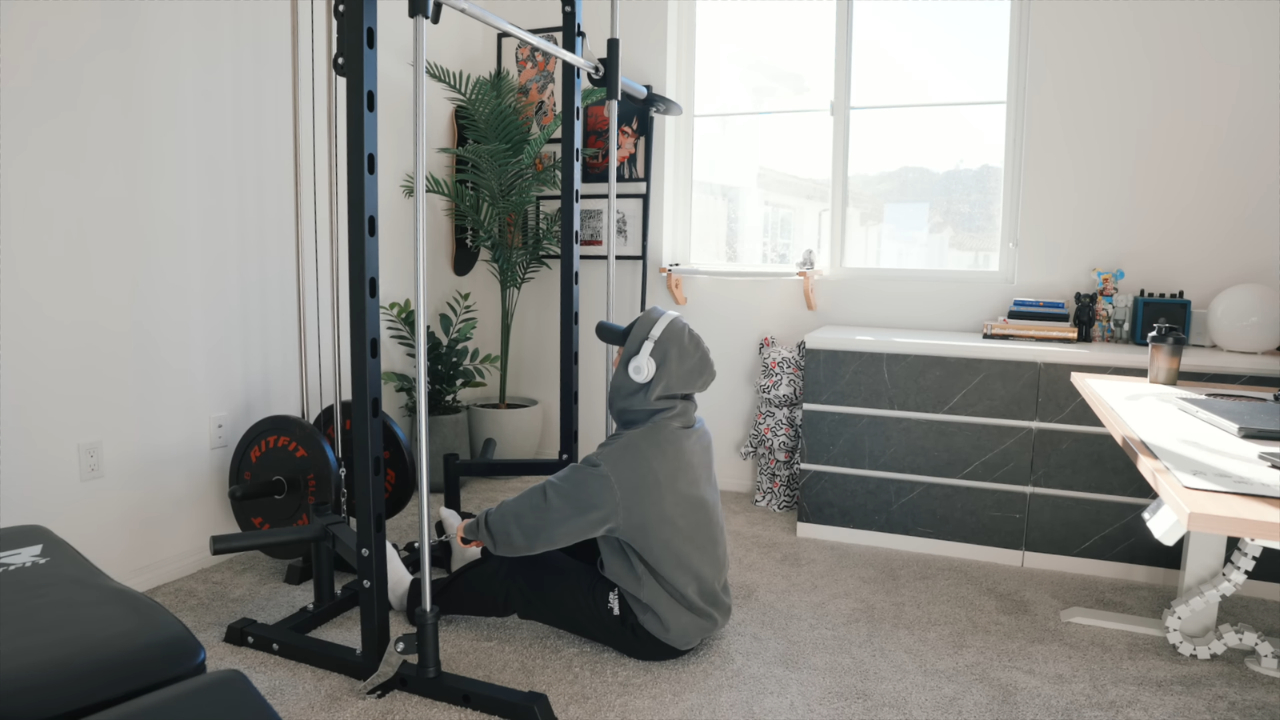
Every few weeks, someone stops me between sets with the same question. They want to train at home, but they live in an apartment and picture the person downstairs banging on the ceiling.
I understand the worry. On the gym floor, I hear dumbbells hit rubber all day, and I know how far that sound travels.
An apartment home gym can work, and most of the answer is in how you train rather than what you buy. The rest comes down to a solid floor setup, a conversation with the landlord before heavy gear arrives, and some thought about timing. Here is how I would set one up.
Why a Dropped Dumbbell Sounds Louder Downstairs
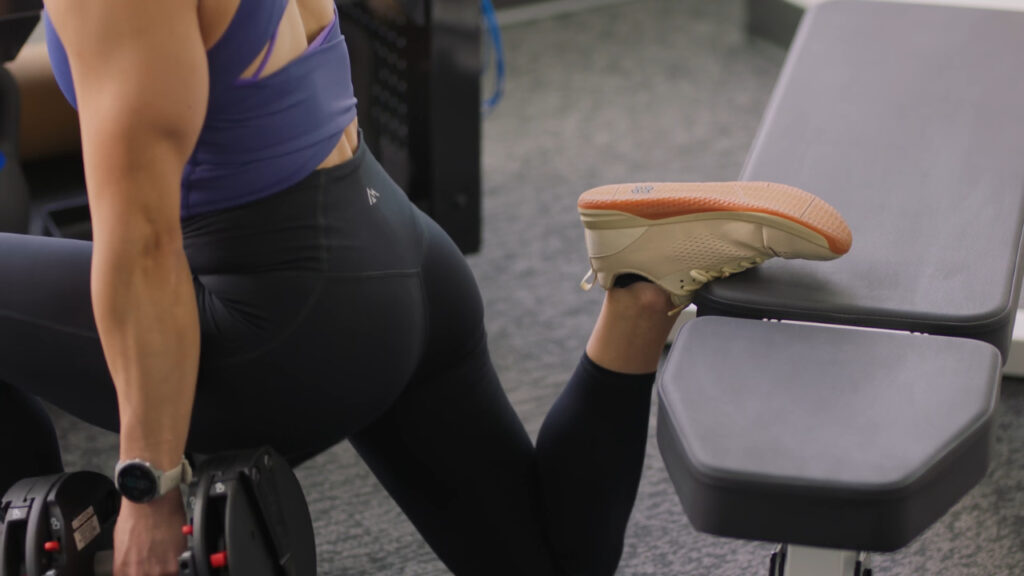
Noise in an apartment travels in two ways. Airborne sound, like music or a voice, moves through the air and loses energy at walls and doors. Impact sound starts when something hits the floor, and the building structure carries that energy straight into the ceiling below.
Weights, jumps, and treadmill footfalls are all impact sound, which is why an apartment home gym can seem quiet in your room and loud downstairs. A 2023 Los Angeles building bulletin on sound-rated assemblies requires floors between dwelling units to provide impact sound insulation, rated 50 in laboratory tests and 45 in field tests.
Impact Insulation Class, or IIC, rates how well a floor and ceiling block impact noise. Higher numbers mean less sound reaches the unit below, but the rating comes from a standard test, not from a 50-pound dumbbell landing from waist height.
Ask the Landlord Before Anything Heavy Arrives
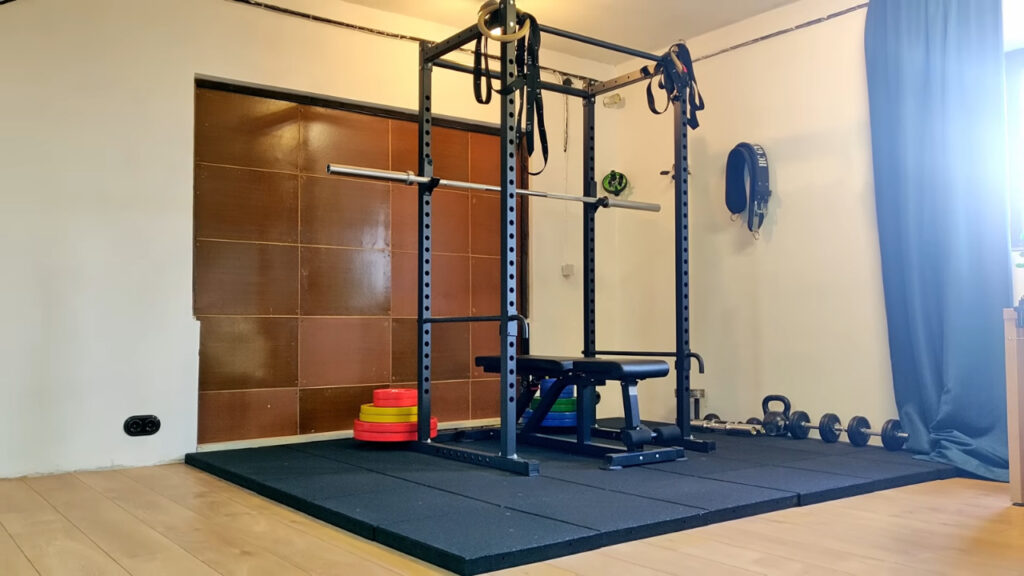
Before you buy a rack, a treadmill or a stack of plates for an apartment home gym, read your lease and send the landlord or building management a short message. Some leases mention heavy equipment, and some buildings have rules about deliveries and elevators.
A written yes protects you if a neighbor complains later. Asking first is also why planning a home gym from the ground up starts with the room and the floor rather than the shopping list.
Floor strength is the other reason to ask. Washington State, for example, sets 40 pounds per square foot for rooms other than sleeping rooms in its residential code.
Larger apartment buildings fall under a different code, and older ones may predate current rules. Only your landlord or a structural engineer can say what your floor was built for.
What Floor Load Numbers Mean for a Home Gym
The key word in those code figures is uniform. A floor rated for 40 pounds per square foot expects weight spread evenly. I ran the numbers for three common setups, using weights that are my assumptions rather than measurements.
| Setup (assumed weights) | Total | Footprint | Average load |
| 180-pound lifter, 100 pounds of adjustable dumbbells | 280 lb | 4 x 6 ft | About 12 lb per sq ft |
| 180-pound lifter, 150-pound rack, 225 pounds of bar and plates | 555 lb | 4 x 8 ft | About 17 lb per sq ft |
| 180-pound runner on a 250-pound treadmill | 430 lb | 3 x 6 ft | About 24 lb per sq ft |
The averages look comfortable but hide the real problem. A rack stands on four small feet, a dropped weight hits far harder than it rests, and the room already holds furniture. For an apartment home gym, treat the table as a reason to ask, not as permission.
Build a Floor That Swallows the Thud
View this post on Instagram
A thin yoga mat does almost nothing for an apartment home gym. Impact noise needs mass to absorb the hit and a soft layer to keep vibration out of the structure.
My own minimum under dumbbells is a 3/4-inch rubber mat, which is a preference rather than a rule. The right mix comes down to picking the right floor surface for the training you do, and I would start with these layers.
- Dense rubber mats, at least 3/4 inch, under the whole lifting area
- A platform for heavier work, with plywood sandwiched between two rubber layers
- Foam crash pads to set dumbbells on between sets
- Rubber pads or isolation feet under a treadmill or bike
- A gap of a few inches between equipment and shared walls
The plywood spreads the load, and the bottom rubber layer separates the platform from the floor.
Train Like the Floor Belongs to Someone Else
Equipment helps, but technique does most of the work. Whenever I build a no-jump circuit, I try it on myself before anyone else does it, and the lesson never changes. Control beats padding.
In an apartment home gym, the downward part of every rep is where noise starts, so that is where I slow things down.
- Lower every weight over about three seconds and set it down rather than letting it go
- Swap jumps for slow step-ups, paused squats and lunges with a quiet foot placement
- Finish sets before your grip fails, so nothing slips at the end
A slow lowering phase also makes lighter weights feel heavier, which suits an apartment home gym where you may not own much. Heavy deadlifts and Olympic lifts are the exceptions I would usually leave for a commercial gym.
Quiet Equipment for an Apartment Home Gym
The quietest equipment never touches the floor hard. Adjustable dumbbells replace a full rack of fixed pairs, and resistance bands make almost no noise. A compact setup in one corner of a room can cover a full-body routine with bands, a mat and one pair of dumbbells.
For cardio, a treadmill sends every footstrike into the floor, so walking is gentler than running. Fan-based bikes and rowers are loud because of the air, while magnetic resistance is usually quieter. I added rowing intervals to my own week, and a rower on a thick mat is far kinder to the floor than a jump rope.
Did you know? In the same Washington code table, sleeping rooms are designed for 30 pounds per square foot, ten less than other rooms. The spare bedroom many people choose for an apartment home gym is, on paper, the room built for the lightest load.
Pick Training Times Around the Building
Timing changes how much your apartment home gym bothers anyone. Quiet hours come from your lease and local rules, not one national standard, so check both. I would avoid early mornings, late evenings and weekend mornings, when people sleep and the building is quiet enough to hear every thud.
Late afternoon and early evening usually work best, because traffic, cooking and televisions already fill the building with background noise. My favorite window is a Saturday afternoon when a big football match is on and half the block is shouting at a screen.
Complaints can escalate, too. In New York City, the NYC311 guidance on neighbor noise says police respond within eight hours when not handling emergencies, and it points regular problems to building management or free mediation.
Talk to the Neighbor Below First
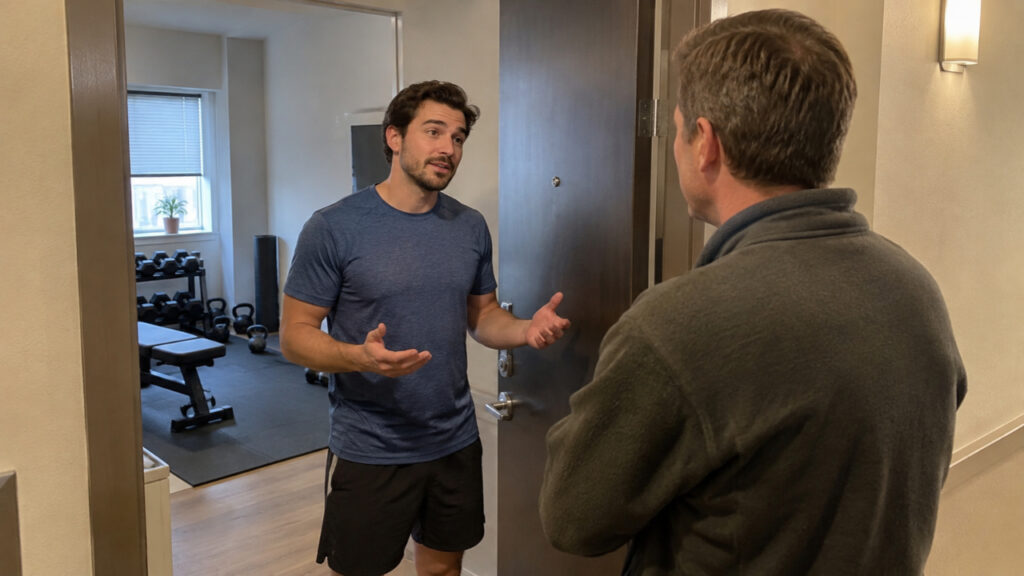
The best soundproofing for an apartment home gym is a two-minute conversation. When members ask me how to handle a downstairs neighbor, I suggest knocking before the first session, explaining when you plan to train and asking them to tell you directly if anything is too loud.
Most people respond well to being asked. A neighbor who knows you lift on Tuesday and Thursday evenings will tolerate a thud far more easily than a mystery bang at 6 a.m.
If they mention a problem, ask which sound bothers them and when, then change that one thing first. The fix is often a crash pad or a different time, not a new floor, and it costs far less than a fallout with the people you share a building with.
Start With One Quiet Session
@i_am_sameer_diwan Apartment gym not too bad #fyp #gym #gymtok ♬ original sound – maczz
Before you buy more equipment for your apartment home gym, train once and listen. Ask someone to stand in the room below or the hallway during a normal session, then note which exercise made the loudest sound. On the gym floor, the loudest moment of a set is almost always the set-down at the end, and an apartment is no different.
Fix that one sound first with a crash pad, a slower lowering phase or a different time. Repeat the test a week later. An apartment home gym grows best one quiet improvement at a time, and the neighbor below may never know you train at all.